Esta análise está escrita em Inglês.
Shopify Review 2026: Worth the Fees for Your Store?
Shopify review 2026: plan prices from $39 a month, the $1 trial offer, what Shopify really takes from each sale, hidden app and theme costs, and who should pay.
Por Simple Life Reviews · Atualizado em
Esta análise foi pesquisada e redigida com auxílio de IA a partir de testes publicados e relatos de usuários, e passou por verificações automáticas de fatos e fontes e por uma revisão editorial. Não testamos o produto pessoalmente. Como analisamos
Alguns links desta análise são links de afiliado. Se você comprar por eles, podemos receber uma comissão, sem custo adicional para você.
Nossa avaliação
The most complete hosted store platform, praised by every tester for checkout, uptime, POS and multichannel selling; app-driven cost creep, the third-party gateway surcharge and tight plan limits cost it a point.
Avaliações por produto
- Shopify
Shopify is the default answer when someone asks how to open an online store, and in 2026 it is also the platform with the most moving parts in its bill: a monthly plan, card rates, a surcharge if you use your own payment processor, apps, themes and hardware. This Shopify review pulls together the hands-on tests from Cybernews, Forbes Advisor, TechRepublic, Style Factory and Network Solutions, plus the cost breakdowns at Gochyu, to answer the question behind every search for it: is Shopify worth the fees for your store, and when does it stop being worth it?
Verdict in short: Shopify is worth it for anyone running a real store with steady sales who can use Shopify Payments; the checkout, uptime, app store and built-in point of sale justify the fee. It is a poor fit for hobby sellers, developers who want full code control, and wholesale-only businesses that would need Shopify Plus too early.

What Shopify is
Shopify is a hosted platform: you build and run the store in a browser, and Shopify supplies the hosting, templates, payment processor, blog and checkout. Style Factory describes it as software you rent monthly rather than own, customisable through apps or its own Liquid templating language. The brand's site now leads with AI, promoting the Sidekick assistant, Agentic Storefronts for selling inside AI chat, and an app store it says holds 21,000+ apps. Every reviewer still frames the product the same way: the easiest way to launch a store that can scale without migrating.
Pricing
Shopify has no free plan. Forbes Advisor describes a three-day free trial followed by three months at $1 per month, after which paid plans start at $39 per month. TechRepublic adds the annual-billing prices: Basic drops to $29 a month, Grow to $79 and Advanced to $299 when you pay for a year up front, while Shopify Plus starts at $2,300 a month on a three-year commitment.
| Plan | Price per month | Limits | Free tier |
|---|---|---|---|
| Shopify Starter | TechRepublic: $5 a month, 5% per transaction | Sell through links and social posts; no full online store or reports | Short free trial, then a dollar-a-month promotion for three months |
| Shopify Basic | TechRepublic: $39 a month ($29 billed annually), 2 staff accounts, 2.9% + 30¢ online card rate | Full store, unlimited products, standard reports, POS Lite, limited international markets | Same trial and promotion |
| Shopify Grow | TechRepublic: $105 a month ($79 billed annually), 5 staff accounts, 2.7% + 30¢ online | Professional reports, lower card rates, more markets | Same trial and promotion |
| Shopify Advanced | TechRepublic: $399 a month ($299 billed annually), 15 staff accounts, 2.5% + 30¢ online | Custom reports, real-time carrier shipping rates, additional markets for a fee | Same trial and promotion |
| Shopify Plus | TechRepublic: from $2,300 a month on a three-year contract, unlimited staff accounts | Up to a couple of hundred locations, wholesale and B2B features, checkout customisation, negotiated card rates | None |
Cancellation is a matter of pausing or closing the store from the admin; you keep paying until you do, and the promotional price converts to the full plan price automatically. The dollar promotion is the right way to test it: build the store, connect a domain and run real orders before the real fee begins.

What Shopify takes from each sale
The plan fee is the smaller half of the bill. Using the built-in Shopify Payments, TechRepublic lists in-person card rates of 2.6% + 10¢ on Basic, 2.5% + 10¢ on Grow and 2.4% + 10¢ on Advanced alongside the online rates in the table, and an extra 2%, 1% or 0.6% of each sale respectively if you process payments through a third-party gateway such as Stripe or PayPal instead.
That surcharge is the single biggest factor in whether Shopify is worth it. Gochyu works the example: on $25,000 of monthly sales through Stripe on the Basic plan, $500 goes to Shopify on top of Stripe's own fee, and on Plus the surcharge falls to 0.2%. In countries where Shopify Payments is not available the fee cannot be avoided, which is the first thing to check before signing up.
The real monthly cost
Reviewers agree the sticker price understates what a working store costs. Gochyu estimates a store doing $1,000 a month pays roughly $70 to $100 all-in on Basic with processing and a couple of cheap apps, a $10,000 store around $400, and a $50,000 store around $1,600 a month on Grow with processing and four or five apps, which it calls 3.2% of revenue and still worth it. Network Solutions puts most paid apps at $10 to $50 a month each and POS hardware at $49 to $459, and names hidden app costs as the biggest drawback in the 100 customer reviews it analysed.
Themes and add-ons stack on top. Style Factory prices premium themes from $100 to $500, with the popular Prestige theme at $400, the POS Pro add-on at $89 per location per month ($67 paid annually), and notes that stores using Shopify Tax pay a 0.25% to 0.35% fee on taxed sales once they pass $100,000, capped at $5,000 a year below $100 million in sales. None of these are hidden exactly, but none appear on the pricing page either.
Store builder and themes
Setup is fast. The Cybernews tester had a basic layout for a trading-card store ready in 10 minutes according to Cybernews, with a finished store in under 30, and found 1200+ designs in the theme store of which 24 were free, with some professional templates costing up to $300. Forbes Advisor notes the new AI Store Builder that generates a storefront from a prompt, and every reviewer calls the default Dawn theme good enough to launch with.
The theme library is the weak spot. Style Factory counts 24 free themes against Wix's 2,982 templates and calls Shopify ungenerous here, and both it and Network Solutions describe the blogging and content-management tools as behind the competition. If your site is content-first with a small shop attached, Squarespace or Wix will serve you better.
Products, inventory and point of sale
Style Factory explains the product limits that catch growing catalogues: up to 2,048 variants per product but only three options (say colour, size and style), one media item per variant and a cap of 250 media items per product, so a product with more variants than that cannot show every image. Inventory syncs across channels, and Forbes Advisor confirms up to 10 locations on Basic, Grow and Advanced and up to 200 on Plus, with transfers, order routing and location-based fulfilment built in rather than bought as an app.
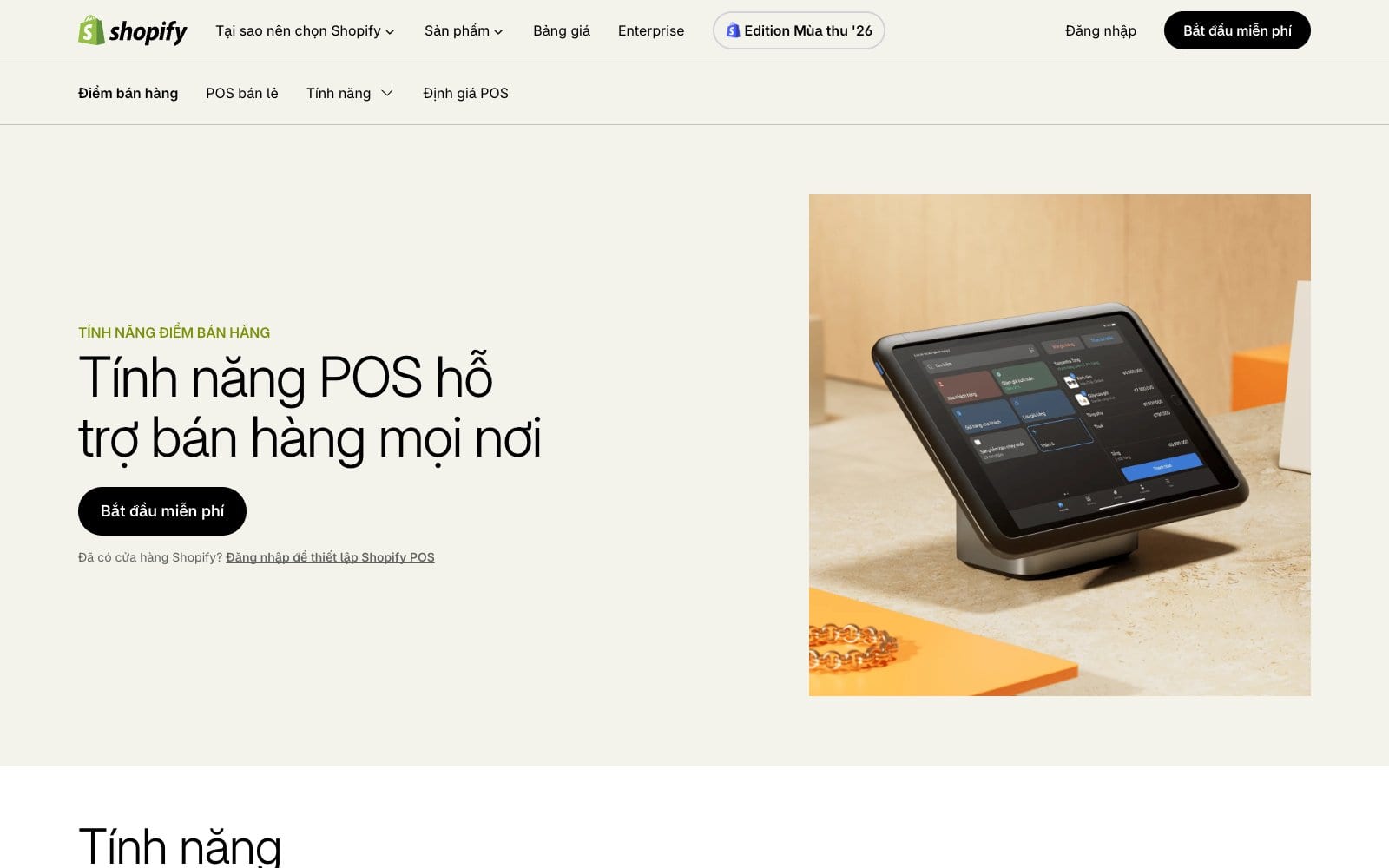
The POS is a genuine differentiator for anyone selling at markets, pop-ups or a shop. POS Lite comes with every plan, inventory updates in real time between online and in-person sales, and POS Pro adds staff permissions and advanced retail features at the per-location fee above. Style Factory includes a working merchant's account of running it day to day, and the verdict is that it works but the Pro pricing stings for multi-location retailers.
Selling everywhere: channels, markets and marketing
Shopify's strongest argument over a general website builder is multichannel selling. Social, marketplace and B2B channels sync to one inventory, Shopify Markets handles multi-currency pricing and localised storefronts, and Shopify Shipping gives discounted labels; Style Factory notes US merchants can save up to 87% on postage on higher tiers and that Shopify Messaging sends 10,000 emails a month free with a $1 fee per additional 1,000. Abandoned-cart recovery, discount codes, gift cards and Shop Pay's one-tap checkout are included on every plan, and Cybernews rates the SEO tools as basic but adequate.
AI and the app store
Sidekick, the AI assistant inside the admin, drafts product copy, analyses sales and suggests next actions, and Shopify Magic generates descriptions and images; TechRepublic treats these as useful time-savers rather than reasons to switch platforms. The app store is the real extension layer: TechRepublic counted nearly 8,000 integrations across marketing, sourcing, accounting and fulfilment, while the brand site now claims far more. The flip side, raised by every reviewer, is dependence: loyalty programmes, subscriptions, upsells and advanced shipping all live in paid apps.
Security & data
Shopify hosts the store, issues the SSL certificate and runs a PCI-compliant checkout, so card data never touches your own servers; reviewers at TechRepublic and Network Solutions list security and hosting among the things merchants do not have to manage. Customer and order data live in Shopify's cloud under its privacy policy, staff access is controlled through the limited staff accounts per plan, and two-factor sign-in is available for every account. The trade-off Gochyu stresses is ownership: your data is exportable, but the storefront itself only exists on Shopify.
Support and reliability
Live chat is available around the clock on all plans. Cybernews was quoted a 5-minute wait and waited 14 minutes, then found the advisor responsive and genuinely helpful rather than scripted; Network Solutions, summarising a hundred user reviews, reports the same wait pattern and describes some answers as scripted and limited to basics. On reliability there is no dissent: fast load times and stable uptime through product drops are praised everywhere, and the hosting, security certificates and PCI-compliant checkout are included.
The downsides, honestly
- The bill grows with you. Apps, premium themes, POS Pro and Shopify Tax turn a cheap plan into a meaningful monthly cost; see the real-cost section above.
- Third-party gateway surcharge. If you cannot or will not use Shopify Payments, Shopify takes an extra slice of every sale, which Gochyu calls punishing.
- Ungenerous limits. Few staff accounts on lower plans, three product options and a media cap per product push merchants up a tier sooner than they expect, per Style Factory.
- Thin free theme choice and weak content tools compared with Wix and Squarespace.
- You do not own the platform. Migrating away is painful, and Network Solutions lists platform lock-in among the common complaints.
- Support quality varies by time and issue, with longer waits than quoted.
Shopify pros and cons
Pros
- Fastest, highest-converting checkout in the category with Shop Pay
- Reliable hosting and uptime, security handled for you
- Built-in POS and inventory that syncs online and in person
- Largest app ecosystem and strong multichannel selling
- Short trial plus a dollar-a-month promotion to test with real orders
Cons
- Monthly cost climbs quickly with apps and themes
- Surcharge for third-party payment processors
- Tight staff, option and media limits on lower plans
- Few free themes, weak blogging
- Plus pricing puts enterprise features out of reach for small B2B sellers
Who it's for
Buy Shopify if you run or are launching a real product store, expect steady orders, sell on more than one channel or in person, and live where Shopify Payments is supported. Gochyu puts the break-even around $1,000 a month in revenue, and solo founders who would rather spend time on product than on platform plumbing are its ideal customer.
Skip it if you sell occasionally or only through social links, want full code-level control, or run a wholesale-only business that would need Plus before the volume justifies it. Content-heavy sites with a small shop are better served by Squarespace or Wix, and developers by WooCommerce.
Alternatives
| Alternative | Monthly price | Where it beats Shopify | Where Shopify wins |
|---|---|---|---|
| Wix | Forbes Advisor: from $17 per month | Far more templates, stronger general website and content tools | Checkout, POS, multichannel, app depth |
| BigCommerce | Not priced in our sources | No extra fee for third-party gateways, more built-in B2B features and product variants | Ease of use, themes, app ecosystem |
| WooCommerce | Free software; hosting and extensions extra | Full code control, no platform fees, WordPress content | Hosting, security and support handled for you |
TechRepublic singles out BigCommerce for including real-time shipping quotes, customer groups and wider variant limits without add-ons, and for not charging gateway fees, which makes it the first alternative to price if you must use Stripe or PayPal. For a small-business toolkit beyond the store itself, our NordPass review covers shared credentials for a team and our Surfshark review the privacy side.
Our ratings
Overall: 4/5. Overall, Shopify earns four because Cybernews rates it 4.4 after three months of running two stores and TechRepublic scores it 4.26 out of 5, both praising checkout, reliability and multichannel selling, while the app-driven cost creep, gateway surcharge and plan limits that every reviewer documents cost it the final point.
Shopify
Shopify scores 4/5. The platform itself is the most complete hosted store builder available, and Style Factory notes the main app is rated 4.7 on Apple's store and 4.2 on Google Play by merchants; the score reflects the real total cost rather than the sticker price.
FAQ
Does Shopify charge transaction fees?
Yes, in two forms. Card processing through Shopify Payments runs from 2.9% + 30¢ on Basic to 2.5% + 30¢ on Advanced for online sales, and if you use another payment processor Shopify adds a surcharge of 2% on Basic, 1% on Grow and 0.6% on Advanced on top of that processor's own fee.
Is Shopify free to use?
No. There is no free plan, but Forbes Advisor confirms a three-day free trial with no card and then three months at $1 per month before the regular plan price applies.
Is Shopify good for beginners?
Yes. Every reviewer built a working store in well under an hour, the admin is clear, and no coding is required unless you want to customise a theme. The learning curve is in the business side: understanding fees, choosing apps and setting up shipping and taxes.
Is Shopify legit and secure?
Yes. It is a publicly traded company that hosts and secures the store for you, including the SSL certificate and a PCI-compliant checkout, and reviewers consistently praise its uptime. Your own security hygiene still matters: use strong passwords and two-factor sign-in for staff accounts.
Is Shopify good for SEO?
Adequate rather than exceptional. Basic SEO settings are pre-configured, page speed is strong, and you can edit titles, descriptions and URLs, but Cybernews and Style Factory both describe the SEO and blogging tools as average compared with content-first platforms.
What is Shopify Capital?
Shopify Capital is the company's merchant funding arm. The brand's site states it has loaned out $5B US, offers funding up to $2M US and takes 0% equity, with repayment typically drawn from sales. It is offered to eligible merchants from inside the admin rather than applied for like a bank loan.
Do I need a business licence to sell on Shopify?
Shopify itself does not require one to open a store. Whether you need a licence, sales-tax registration or a resale certificate depends on your country, state and what you sell, so check local rules before your first sale.