Esta reseña está escrita en Inglés.
Surfshark Review 2026: Cheap VPN, Costly Renewals
Surfshark review 2026: what the VPN really costs after the first term, how fast six labs found it, the connection-log caveat, and who should buy or skip it.
Por Simple Life Reviews · Actualizado
Esta reseña se ha elaborado y redactado con ayuda de IA a partir de pruebas públicas y opiniones de usuarios, y después ha pasado por comprobaciones automáticas de datos y fuentes y por una revisión editorial. No hemos probado el producto personalmente. Cómo analizamos
Algunos enlaces de esta reseña son enlaces de afiliado. Si compra a través de ellos, podemos recibir una comisión, sin coste adicional para usted.
Nuestra valoración
Lowest long-term price among the big names, unlimited devices, audited no-logs policy and lab speeds that match pricier rivals; renewal hikes, brief connection timestamps and weak phishing blocking cost it a point.
Valoraciones por producto
- Surfshark
Surfshark sells one idea very well: one account, every device in the house covered, at one of the lowest two-year prices of any mainstream VPN. In 2026 it has grown into a bundle that adds antivirus, scam alerts, a private search engine and a fake-identity generator on top of the VPN. This Surfshark review brings together the hands-on tests published by PCMag, Cybernews, CyberInsider, Tom's Guide, TechRadar and CNET, the company's own pricing and policy pages, and its audit record, to answer the questions people actually search for: is it safe, how fast is it, and what does it really cost once the introductory term ends.
Verdict in short: Surfshark is the right pick for households, students and frequent travellers who want unlimited devices on a budget and are willing to prepay for two years. Skip it if you need a month-to-month plan, port forwarding for seeding torrents, or a provider that keeps no connection data at all, even briefly.
What Surfshark is and who owns it
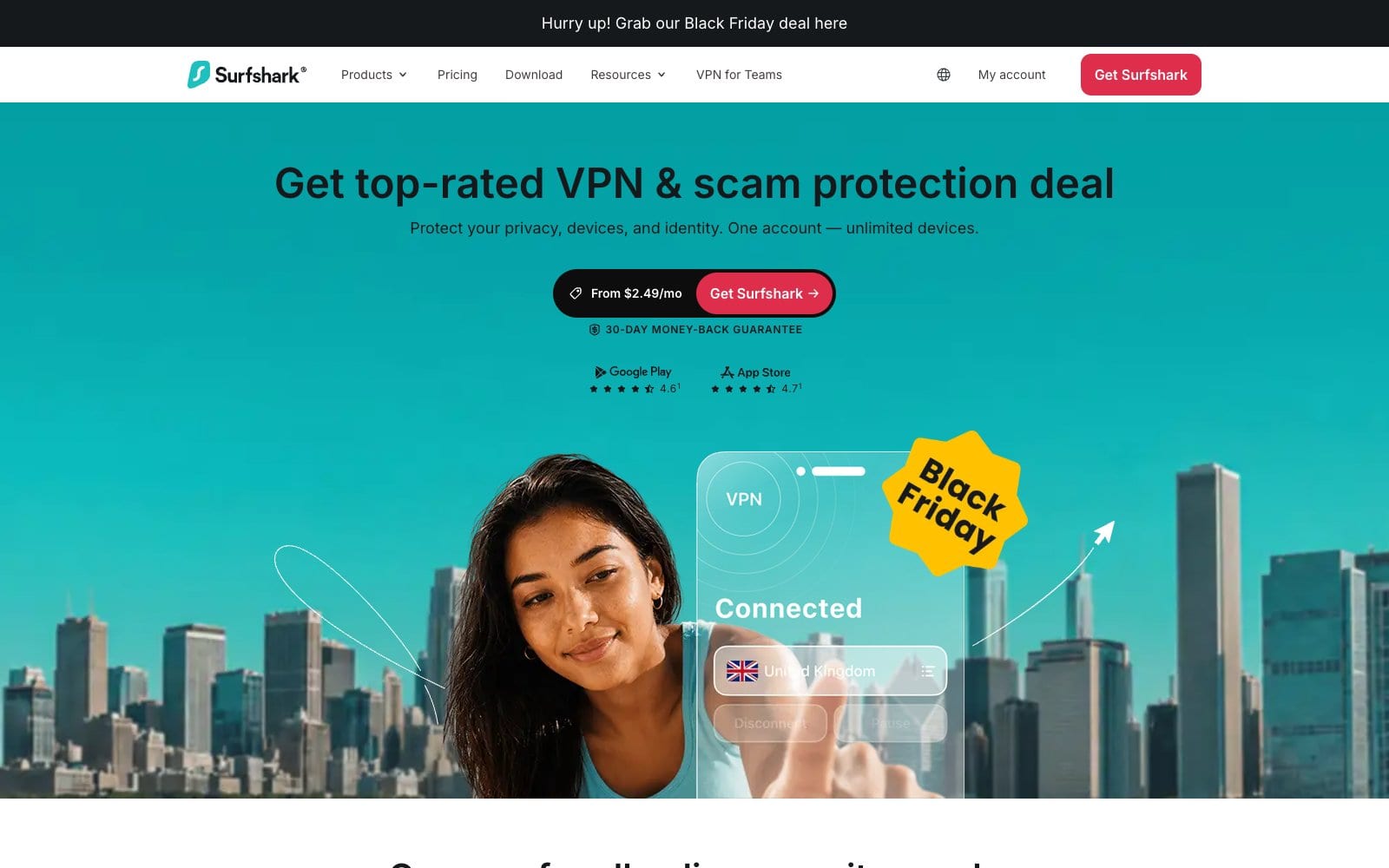
Surfshark launched in 2018 and, according to Tom's Guide, merged into the Nord Security group in 2022, the company behind NordVPN. The two VPNs still run separate apps, server fleets and feature sets, but they share a parent, which matters if you are weighing it against our NordVPN review. CyberInsider's reviewer notes the company is headquartered in the Netherlands and has broadened well beyond the VPN into antivirus, an Alternative ID persona tool, scam-text screening and the Incogni data-removal service.
The company's own site leans on scale: surfshark.com claims 40M+ app downloads and 30+ industry awards, plus a no-logs promise and a 30-day refund window. Those are marketing figures, so the rest of this review relies on what independent testers measured.
Pricing
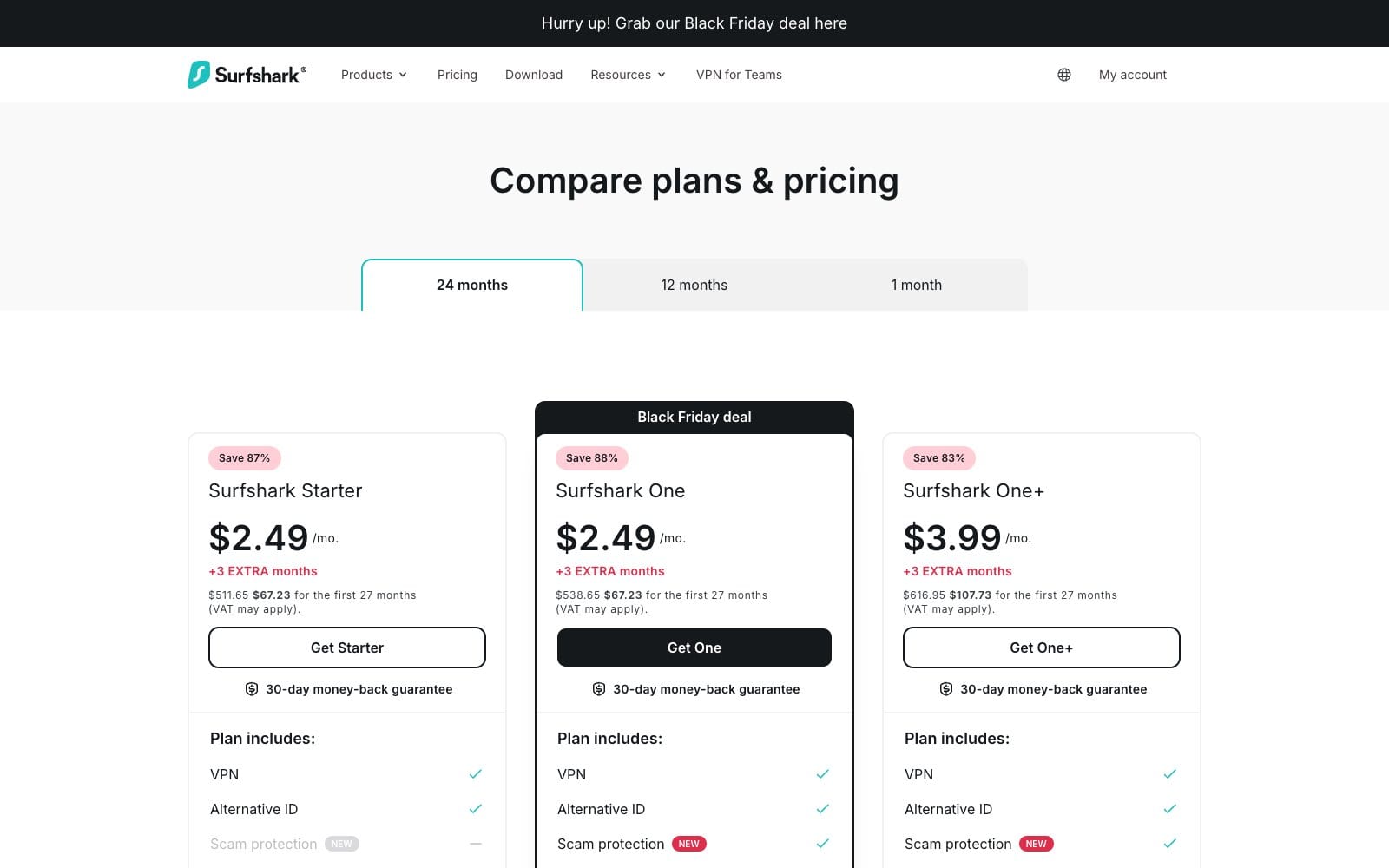
Surfshark's price depends almost entirely on how long you commit, and the headline number changes with every promotion. The most recent snapshot comes from CNET, dated October 1, 2026: Surfshark Starter costs $19 a month, $45 for the first year or $67 for the first two years, and the annual and two-year plans renew at $79 a year once the promotional term is over. Surfshark One is $20 a month, $50 for the first year or $75 for two years, renewing at $99 a year, and Surfshark One+ is $23 a month, $105 for the first year or $121 for two years, renewing at $119 a year.
Earlier in 2026 the monthly rate was lower. PCMag, updated in May, listed Starter at $15.45 a month, One at $17.95 and One+ at $20.85, with the two-year Starter plan working out to $1.99 a month ($53.73 for 27 months), the annual plan to $3.19 a month ($47.85 for 15 months), and the average monthly price among the VPNs it has tested at $10.34, which is why every outlet calls the one-month option poor value. Tom's Guide quotes the two-year Starter plan at $2.49 a month ($67.23 upfront) and Surfshark One from $2.19 a month ($59.13 upfront), so expect the advertised per-month figure on the long plan to sit somewhere between two and three dollars.
| Plan | Price per month | Limits | Free tier |
|---|---|---|---|
| Surfshark Starter | CNET: $19 monthly, $67 for the first two years, renews at $79 a year | VPN, CleanWeb ad and cookie blocker, Alternative ID; unlimited simultaneous devices | Free trial on the annual and two-year plans, then a money-back guarantee |
| Surfshark One | CNET: $20 monthly, $75 for the first two years, renews at $99 a year | Everything in Starter plus antivirus, Alert data-leak monitoring, email scam checker, web content blocker and private Search | Same trial and refund terms |
| Surfshark One+ | CNET: $23 monthly, $121 for the first two years, renews at $119 a year | Everything in One plus Incogni data removal and identity-theft coverage | Same trial and refund terms |
There is no free plan. Tom's Guide describes a 7-day free trial with no feature limits that asks for payment details first and charges nothing if you cancel before the week is up. CNET adds that the trial applies to the annual and two-year plans and is followed by a 30-day money-back guarantee on every plan, with Apple Pay, Google Pay, cards, PayPal and crypto accepted. To cancel, turn off auto-renewal in your account before the term ends; the renewal rates above are what you pay if you forget.
One paid extra is worth knowing about. A dedicated IP address costs an additional $3.75 a month on any plan according to PCMag, has to be added after the initial purchase, and is offered in a limited set of countries. Static shared servers, by contrast, are free.
Features: what the bundle actually gives you
The core VPN runs WireGuard, OpenVPN and IKEv2 on mobile, and PCMag singles out the newer proprietary Dausos protocol as a reason it handed Surfshark an Editors' Choice award. Tom's Guide found post-quantum encryption switched on by default with WireGuard, a detail most rivals still treat as optional.
Alternative ID generates a fake name, address and email alias you can hand to sign-up forms so your real details never reach a spam list. TechRadar's reviewer treats it as the standout extra, and it is included even on the cheapest plan.
CleanWeb blocks ads, trackers, cookie banners and malware domains inside the VPN app and browser extension; the newer CleanWeb 2.0 version, as CyberInsider describes it, also strips pop-ups and cookie prompts. It is not a full ad blocker replacement, and TechRadar's phishing test (covered under Security below) shows its limits.
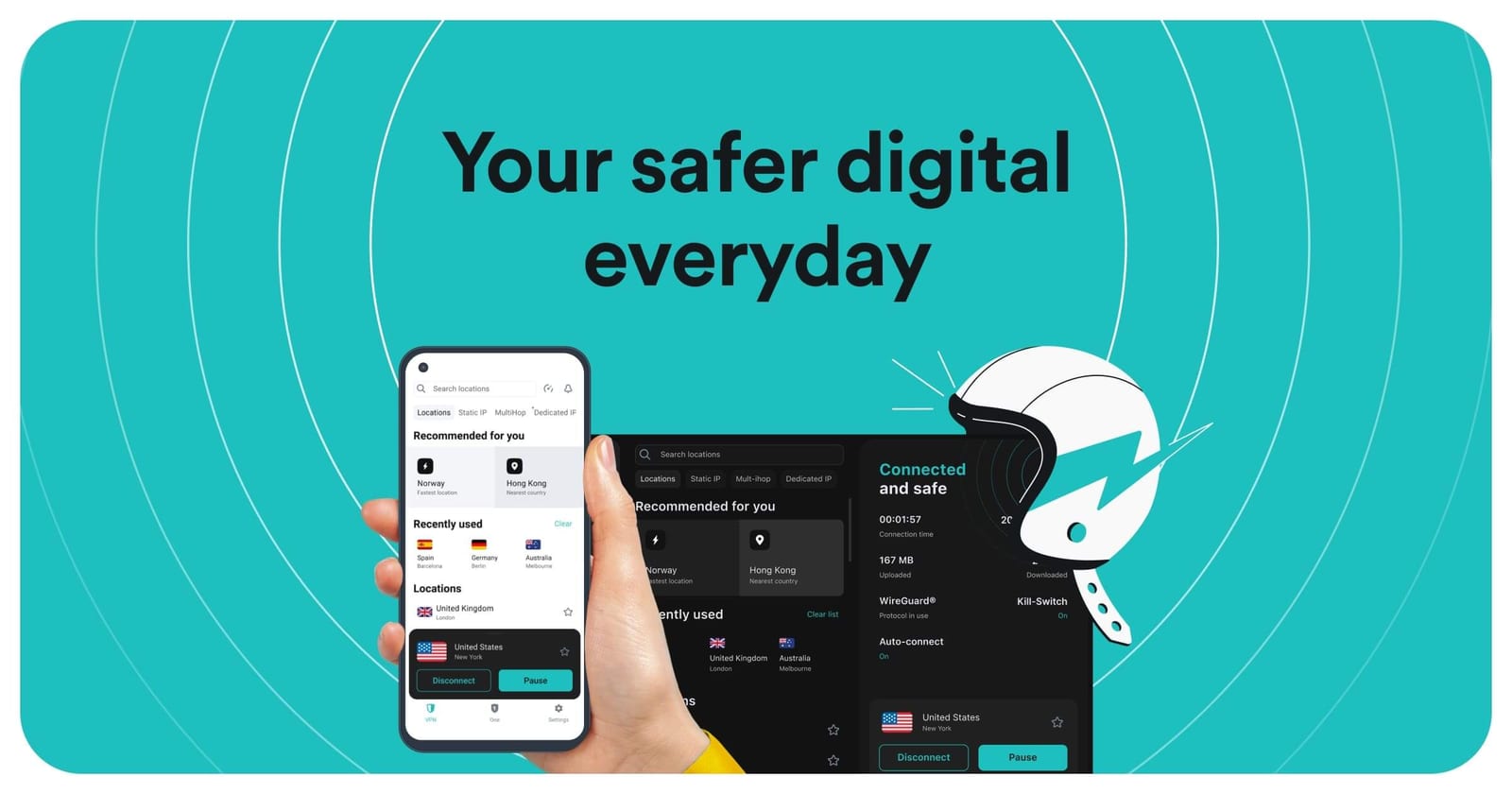
Bypasser is Surfshark's split tunneling. Tom's Guide calls it unusually flexible: you can route individual apps or websites outside the tunnel, which is handy for banking apps that refuse VPN traffic. CNET notes it works on macOS, iOS, Windows and Android, and praises a pause button that drops the connection for 5 minutes, 30 minutes or 2 hours and then reconnects on its own.
Dynamic MultiHop and Camouflage mode cover the advanced cases: MultiHop chains two servers of your choosing, and Camouflage mode is Cybernews' name for the obfuscated servers that disguise VPN traffic as ordinary HTTPS, which is what you would lean on in restrictive networks.
Surfshark One adds an antivirus that Tom's Guide describes as Avira-backed and effective, plus Alert, which emails you when your credentials, card numbers or ID appear in a breach. One+ layers on Incogni, which sends removal requests to hundreds of data brokers on your behalf, and identity-theft insurance.
Speed: fast nearby, laggy far away
Nobody at Simple Life Reviews ran a speed test; what follows is the spread of results from six labs, which agree on the shape even where the numbers differ.
| Lab and result | What it means |
|---|---|
| PCMag: download down only 7.73%, upload down 7.12%, latency up 201.34% | Among its fastest VPNs for throughput, but the latency jump matters for gamers and video calls |
| Cybernews: on a 940Mbps line kept 89% to 95% to the UK, Netherlands and Sweden, about 82% to the US and Canada, lost nearly 80% to Australia (an earlier run retained 68%) | Excellent in-region, weak on the longest hops |
| CyberInsider: on a 1,000 Mbps US line over WireGuard, 752 Mbps Seattle, 653 Mbps Los Angeles, 637 Mbps New York, 556 Mbps UK | Far above what any home connection needs |
| Tom's Guide: on a 10 Gbps line, 1,012 Mbps US to US and 935 Mbps US to UK; latency 21.7 ms domestic versus 14.2 ms Proton VPN and 17.2 ms NordVPN, and 171 ms transatlantic versus 90.6 ms Proton VPN, 82 ms NordVPN, 75 ms ExpressVPN | Raw speed is competitive; latency trails the big three |
| TechRadar: WireGuard averaged 2005 Mbps, up from 1021 Mbps, beaten only by Windscribe at 2263 Mbps, Mullvad at 2308 Mbps and PrivadoVPN at 2334 Mbps | One of the fastest results TechRadar has recorded |
| CNET: 27.3% loss on macOS and 36% on Windows over Wi-Fi, 37.4% and 34.3% over Ethernet | The most conservative numbers, praised for staying steady test to test |
The takeaway: on a server in your own region Surfshark is as quick as anything on the market; connect across an ocean and the added latency is noticeable.
Server network
Surfshark's footprint is wide rather than deep. It covers more countries than any budget rival, but fewer servers and fewer city-level locations than NordVPN, Proton VPN or ExpressVPN.
| Provider | Network size (as reported) |
|---|---|
| Surfshark | Tom's Guide: over 1,000 servers added in October 2025, taking the total past 4,500 across 142 locations in 100 countries |
| NordVPN | TechRadar: 135 countries and 211 locations |
| Proton VPN | Cybernews: 21,200+ servers in 149 countries |
| ExpressVPN | Tom's Guide: 108 countries |
| Private Internet Access / PrivadoVPN | Tom's Guide: 91 and 68 countries respectively |
TechRadar adds a regional wrinkle: Surfshark's 34 North American locations are close to Proton VPN's 35 but far below NordVPN's 74 and ExpressVPN's 71, so US users who want a server in a specific city have fewer choices. CyberInsider notes the whole fleet is RAM-only and that many locations run multi-gigabit links, which is why the per-server throughput holds up despite the smaller count.
Streaming, torrenting and gaming
For streaming, the labs mostly agree. Cybernews gave Surfshark top marks after streaming in 4K without interruption, and CyberInsider reached 15+ Netflix libraries along with Max, Disney+, Hulu and BBC iPlayer. TechRadar is the dissenting voice: its reviewer found Surfshark more hit and miss than the best streaming VPNs on some services, while still working reliably for Netflix and BBC iPlayer. If a specific platform is your reason for buying, use the trial week to check it.
Torrenting is allowed on the network and the no-logs policy covers it, but Tom's Guide lists the lack of port forwarding as a reason to avoid, which hurts anyone who seeds rather than just downloads.
For gaming, the speed table above is what matters: on a local server the latency penalty is small, but the 171 ms transatlantic figure Tom's Guide recorded means you should not expect to play competitively on a server abroad.
Security & data
Jurisdiction. Surfshark is headquartered in the Netherlands. CyberInsider points out that the country belongs to the wider Fourteen Eyes intelligence-sharing network but currently imposes no general data-retention mandate on consumer VPN providers.
Logging and audits. The policy is no activity logs, and the company's Trustpilot profile states that policy is regularly audited by Deloitte. The caveat that keeps coming up is connection data. PCMag explains that timestamps are kept for 15 minutes after a session ends, anonymised, to stop abuse of the unlimited-device policy, and that no IP addresses, browsing history or session details are stored. CNET treats that temporary collection as a gap serious enough to hold its privacy score down and to steer users with critical privacy needs elsewhere, while judging casual users fine.
Infrastructure. Every server is diskless and RAM-only, so nothing survives a reboot or a seizure. Cybernews recorded no DNS or IP leaks in its tests, and Tom's Guide saw the kill switch stumble briefly under heavy testing without ever exposing the real IP address.
Threat blocking. This is the weak spot. TechRadar found CleanWeb blocked only 48% of phishing sites in its test, against 76% for ExpressVPN, 88% for Proton VPN and 92% for NordVPN, though it notes NordVPN's stronger protection needs a pricier tier at a minimum of $3.89 a month while CleanWeb comes with every Surfshark plan.
Apps, usability and support
The brand's own site lists apps for Windows, macOS, Linux, iOS, Android, smart TVs, consoles and routers, and every outlet rates the apps as among the simplest to use. TechRadar counted the clickable controls in the Windows app and found the same number as NordVPN, so simple does not mean stripped down. Tom's Guide's reservation is that advanced users will miss the deeper configuration that Private Internet Access and Proton VPN allow, and CNET reports minor bugginess in the Windows app.
Support is live chat around the clock, and TechRadar names excellent customer service as a reason to buy. PCMag's reviewer also got a direct answer from the company about its high monthly price, which it defended by pointing to the cheapest two-year plan on the market.
The downsides, honestly
The Surfshark complaints that recur across reviews are about money and privacy, not about the VPN failing to work.
- Renewal shock and monthly cost. CNET lists Starter renewing at $79 a year after a $45 first year, One at $99 after $49, One+ at $119 after $105, and a single month of Starter at $19 against Mullvad at 5 euros, Windscribe at $9 or Proton VPN at $10. Tom's Guide and TechRadar both list the hikes among their reasons to avoid.
- Temporary connection data. The anonymised timestamps described above are standard for unlimited-device VPNs but still a mark against it for the most privacy-sensitive users.
- No port forwarding and limited advanced settings, per Tom's Guide.
- Long-distance latency is clearly higher than NordVPN or Proton VPN in Tom's Guide's and PCMag's measurements.
- Streaming is good, not perfect, with TechRadar reporting misses on some services.
Surfshark pros and cons
Pros
- Unlimited simultaneous connections on every plan
- Among the cheapest two-year prices of any premium VPN
- RAM-only servers in a hundred countries with an audited no-logs policy
- Alternative ID, Bypasser and a real antivirus in the One tier
- Very fast on nearby servers in every lab test
Cons
- Steep renewal prices after the first term
- Poor value month to month
- Connection timestamps kept briefly
- No port forwarding
- Weak phishing-site blocking compared with rivals
Who it's for
Buy Surfshark if you are covering a household or several personal devices, you can prepay for two years, and you want extras like antivirus, breach alerts and a disposable identity without buying three separate subscriptions. It is also a sensible choice for travellers who want reliable Netflix and BBC iPlayer access and a kill switch that holds.
Skip it if you only need a VPN for a month or two, you seed torrents and need port forwarding, you compete in online games on servers abroad, or you want a provider that stores nothing at all about your connection. In those cases the alternatives below fit better.
Alternatives
| Alternative | Monthly price | Where it beats Surfshark | Where Surfshark wins |
|---|---|---|---|
| NordVPN | PCMag: $12.99 a month | More countries and city-level locations, stronger phishing blocking, lower latency | Cheaper long-term plans, unlimited devices |
| Proton VPN | PCMag: $9.99 a month | Far larger server fleet, best phishing protection, more frequent audits | Price, bundled antivirus and identity tools |
| Mullvad | CNET: 5 euros a month | Flat pricing with no renewal games, anonymous accounts | Streaming, apps, extras, device count |
Surfshark vs NordVPN is the obvious comparison because the two share a parent company: it covers more countries and more city locations, and TechRadar finds its cheapest two-year plan noticeably dearer than Surfshark's. Our own NordVPN review covers that trade-off in detail, and if what you really need is the breach-alert side of Surfshark One, a dedicated manager such as the one in our NordPass review may be the better buy.
Our ratings
Overall: 4/5. Surfshark earns that overall score by pairing what TechRadar calls the best cheap VPN deal with unlimited devices, an audited no-logs policy and speeds that match far dearer rivals; it loses a point for renewal pricing, the brief connection timestamps and the weak phishing filter.
Surfshark
Surfshark scores 4/5. The evidence is consistent across outlets: PCMag made it an Editors' Choice, TechRadar awarded 85 out of 100 with full marks for price and features, and CNET rated it 8.6 with privacy its lowest category, while its Trustpilot profile records the Deloitte audits. The same reviews document the renewal hikes and the temporary connection data that stop us going higher.
FAQ
Is Surfshark safe?
Yes for ordinary use. The policy is audited no activity logs on RAM-only servers, Cybernews found no leaks in testing, and the apps default to modern encryption. The one caveat is that anonymised connection timestamps are kept briefly after each session; if even that is unacceptable, pick a provider that stores nothing.
Does Surfshark keep logs?
It keeps no browsing history, IP addresses or session content. PCMag explains that the only data retained is an anonymised timestamp held for 15 minutes to police the unlimited-device policy, and the company's Trustpilot profile states the no-logs policy is regularly audited by Deloitte.
Who owns Surfshark?
Surfshark is part of Nord Security, the company behind NordVPN. Tom's Guide dates the merger to 2022, four years after Surfshark's 2018 launch, and CyberInsider notes the two brands keep separate apps and infrastructure under a Netherlands headquarters.
Does Surfshark have a free trial?
There is no free plan, but Tom's Guide describes a 7-day full-feature trial that requires payment details and charges nothing if you cancel in time, followed by a 30-day refund period for new customers. The trending search for a free Surfshark has no other honest answer.
How much does Surfshark cost?
As of October 2026, CNET lists Starter at $19 a month or $67 for the first two years, One at $20 a month or $75 for two years, and One+ at $23 a month or $121 for two years, with renewals at $79, $99 and $119 a year respectively. Promotions change often, so check the per-month figure and the renewal rate before paying.
Is Surfshark good for gaming?
On a server near you, yes: every lab found throughput within a few percent of the baseline. Across long distances the latency climbs, and Tom's Guide recorded 171 ms from the US to the UK, so gaming on foreign servers will feel sluggish.
Does Surfshark work in China?
Surfshark offers obfuscated servers, which Cybernews calls Camouflage mode, designed to hide VPN traffic from network filters. Reviewers say it can work in restrictive countries but connectivity there changes constantly, so install and test the apps before you travel and keep the trial window in mind.
Is Surfshark worth it?
On a two-year plan, yes, for most people who want every device covered and a few security extras; TechRadar calls it the best cheap VPN and finds NordVPN's cheapest plan noticeably more expensive. Month to month it is not worth it, and renewal rates roughly double, so set a reminder before the term ends.